

The cheapest way to move crypto between wallets is usually to send the coin you already own over a low-fee network. Solana, Stellar and the XRP Ledger charge a tiny fraction of a cent in network fees. Ethereum Layer 2 networks such as Base and Arbitrum also cost less than Ethereum’s main network.
However, the lowest network fee does not always give the lowest total cost. Exchange withdrawal fees, trading spreads and bridging charges can cancel out the savings. Picking the wrong network can even lead to lost funds.
This article looks at the numbers behind crypto transfer fees as of 27 October 2026. It covers Bitcoin, Ethereum, Solana, XRP, Stellar, the Lightning Network and stablecoins. Where a figure is an example and not a live quote, the text says so.
How Crypto Transfer Fees Work
Crypto transfer costs fall into two main groups. The first is the network fee paid to the blockchain. The second is the withdrawal fee that an exchange may add.
Network Fees
Network fees pay validators or miners, or otherwise support the running and security of a blockchain. On Ethereum, these charges are called gas fees. Bitcoin uses a fee based on the size of the transaction and the fee rate the sender picks.
For most Bitcoin transactions, the amount sent does not set the fee. Moving $100 and $100,000 can cost about the same if both use the same amount of block space. Ethereum works another way, using gas units multiplied by the gas price.
Ethereum’s official documentation says a simple ETH transfer uses 21,000 gas units. Token transfers that use smart contracts generally need more.
Exchange Withdrawal Fees
Exchanges can charge withdrawal fees that are higher than the blockchain cost. These depend on the platform and the network chosen. Kraken, for example, publishes withdrawal fees and minimum amounts for each supported asset.
Its fee schedule has listed very different charges for USDT withdrawals over Ethereum, Solana, Polygon and TRON. Kraken also warns that fees can change and tells customers to check the final amount before sending.
This means a person could pay several dollars to leave an exchange, even when the blockchain itself charges less than one cent.
Bitcoin Fees by Fee Rate
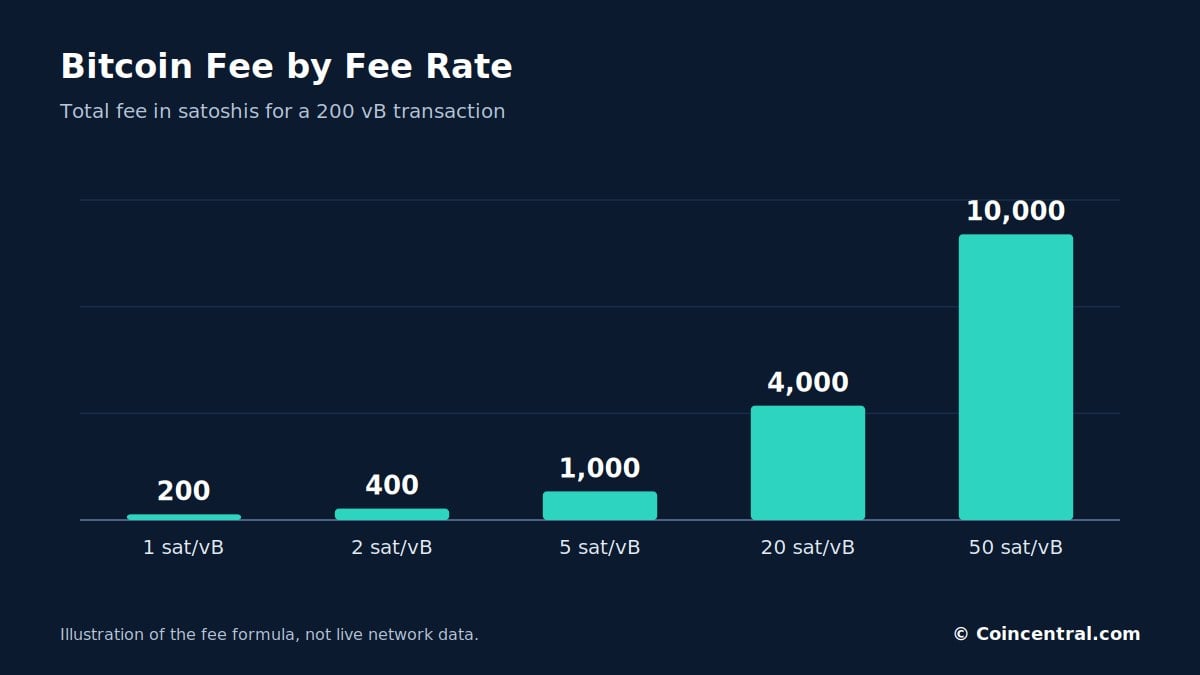
Bitcoin fees are quoted in satoshis per virtual byte, written as sat/vB. A satoshi is one hundred-millionth of a Bitcoin. The table below shows the fee for a transaction that takes up 200 virtual bytes.
| Selected fee rate | Total transaction fee |
|---|---|
| 1 sat/vB | 200 satoshis |
| 2 sat/vB | 400 satoshis |
| 5 sat/vB | 1,000 satoshis |
| 20 sat/vB | 4,000 satoshis |
| 50 sat/vB | 10,000 satoshis |
These figures show how the math works. They are not current network conditions. Live fee estimates are available from Bitcoin Mempool.
When demand is low, a lower fee rate can cut costs. A fee set too low can leave a transaction unconfirmed for a long time. Wallets that support Replace-by-Fee (RBF) let users raise the fee on an eligible pending transaction.
Which Networks Have the Lowest Native Fees
Several networks are built for cheap transactions. Stellar (XLM), XRP and Solana (SOL) have very low native fees. Ethereum Layer 2 networks also cost less than the main Ethereum network in many cases.
Transfer Networks Compared
| Cryptocurrency or network | Typical fee characteristics | Best use |
|---|---|---|
| Stellar (XLM) | Base fee of 0.00001 XLM per operation | Low-cost XLM payments |
| XRP Ledger | Standard minimum of 0.00001 XRP | Fast, inexpensive XRP transfers |
| Solana (SOL) | Base fee of 0.000005 SOL per signature | SOL and supported stablecoin transfers |
| Base | Generally low transaction fees | ETH and supported ERC-20 tokens |
| Arbitrum One | Generally lower costs than Ethereum mainnet | Ethereum ecosystem transfers |
| Polygon PoS | Generally inexpensive transactions | Supported tokens and stablecoins |
| Bitcoin Lightning | Low routing fees, with provider charges varying | Small and frequent BTC payments |
| Litecoin (LTC) | Generally inexpensive on-chain transfers | Direct LTC transfers |
| TRON | Variable fees based on bandwidth and energy | TRX and supported USDT transfers |
| Ethereum mainnet | Variable gas fees, potentially much higher during congestion | Direct ETH and ERC-20 transfers |
| Bitcoin mainnet | Fees depend on transaction size and network demand | Direct BTC transfers and long-term settlement |
This table describes network-level costs. It does not show exchange withdrawal charges. Actual fees vary by transaction, wallet, network activity and provider.
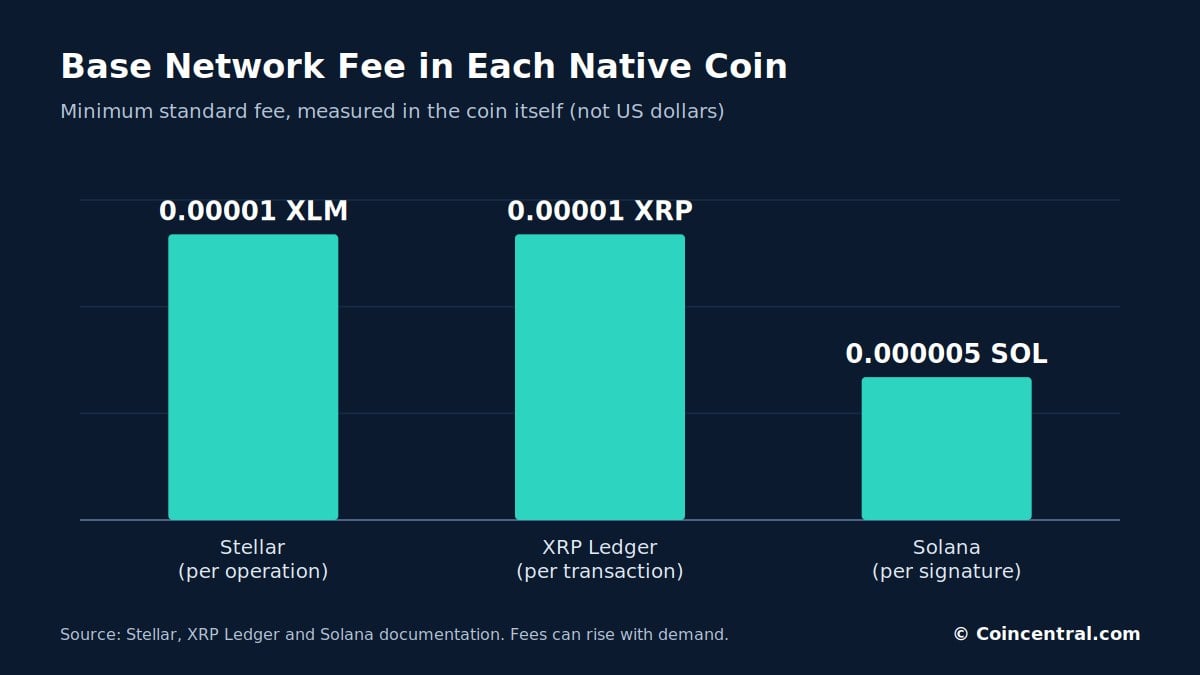
Official documentation confirms the low base fees. Stellar charges a minimum of 0.00001 XLM per operation. The XRP Ledger sets a standard minimum cost of 10 drops, which equals 0.00001 XRP, though this can rise when the network is busy.
Solana uses a base fee of 5,000 lamports per signature. One SOL holds one billion lamports, so the base fee is 0.000005 SOL. Solana also allows an optional priority fee.
Account Requirements
Low fees come with some account rules. The XRP Ledger generally needs a base reserve of 1 XRP to activate an account. Stellar also has minimum balance rules.
These are funding requirements, not transaction fees. Some exchange deposit addresses also need a destination tag or memo. If it is missing, the deposit may not be credited even though the coins reached the right address.
Should You Convert Bitcoin Into XRP to Save Money?
Not automatically. Say a person holds $2,000 in Bitcoin and wants to move it to another exchange. Swapping to XRP might cut the transfer fee.
But the person would also pay to trade into XRP and maybe to trade back. Trading fees, spreads and price changes can make this costlier than a direct Bitcoin transfer. The swaps may also be taxable in places such as the United States and United Kingdom.
For people who already hold XRP or Stellar, the transfer itself is very cheap. For everyone else, the math needs a closer look.
Solana: Very Low Fees With One Extra Cost
Solana is a practical choice for moving supported coins between self-custody wallets. Its standard base fee is 5,000 lamports per signature. That is 0.000005 SOL.
The full cost can include a priority fee. For ordinary transfers, the total is usually tiny compared with the amount moved.
Sending USDC on Solana
Suppose an investor wants to send $1,000 in USDC from one Solana wallet to another. If both wallets support native USDC on Solana, the transfer usually needs no conversion. The sender needs a small SOL balance to pay the fee.
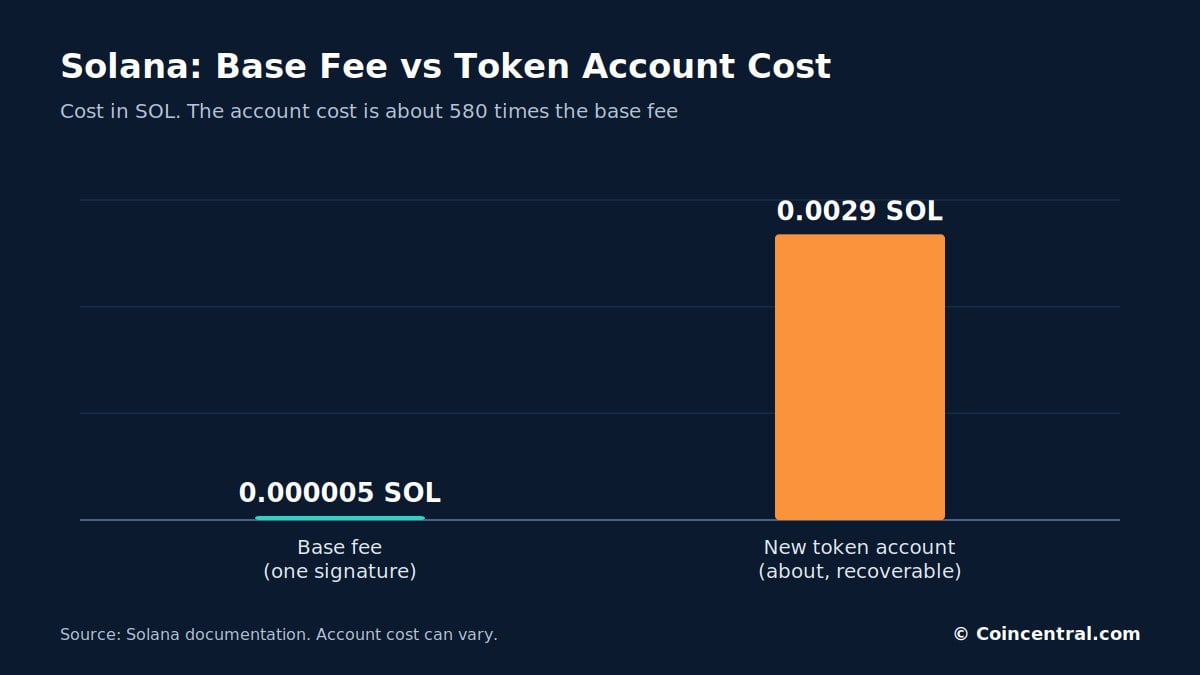
There is one extra cost to know about. Solana token accounts need storage funding, and creating a new receiving token account adds an upfront charge.
Solana’s payment documentation shows account creation costs of about 0.0029 SOL. This can vary, and the amount is generally recoverable when the account is closed properly. Compared with the base fee, that is 580 times higher.
So sending tokens to an existing account can cost less than sending them to a wallet that holds that token for the first time.
Solana is a strong low-cost option when both wallets already support the same Solana-based coin.
Layer 2 Networks and Stablecoin Transfers
Base, Arbitrum and Optimism
Ethereum is widely used, but sending assets on its main network can cost more than on other networks. Layer 2 networks handle transactions separately and use Ethereum for settlement and security. Popular options include Base, Arbitrum and Optimism.
Arbitrum’s documentation says its charges cover the cost of running transactions on Arbitrum and of posting data to the underlying blockchain. Fees vary, but they are generally lower than Ethereum mainnet.
There is a catch. The asset must already be on the Layer 2 network. A person with USDC on Ethereum mainnet cannot pick Base in a self-custody wallet and send those same tokens there.
The assets first need to move through a bridge or a similar tool. That step can add fees.
Which Network Is Cheapest for USDT?
No network is permanently the cheapest for USDT. USDT runs on Ethereum, TRON, Solana and others. USDC runs on Ethereum, Base, Solana and more.
Solana and Layer 2 networks can offer cheap transfers. But the final charge depends on where the coins are held and what the exchange adds.
TRON is widely used for USDT, and its fees are often misunderstood. It uses two resources called bandwidth and energy. Ordinary transactions use bandwidth, while smart contract actions such as TRC-20 token transfers also use energy.
Users can get these resources by staking or delegation, or pay with TRX. This means USDT on TRON is not always cheaper than Solana or a Layer 2 network.
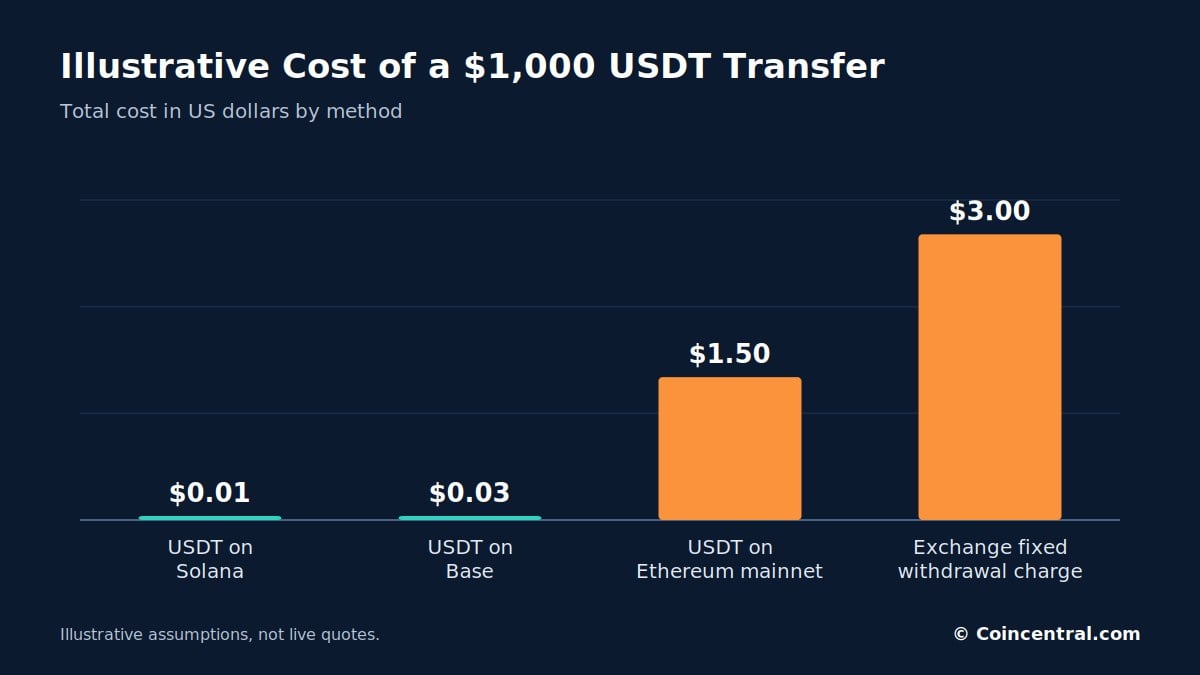
Example: A $1,000 USDT Transfer
| Transfer method | Illustrative total cost |
|---|---|
| USDT on Solana | $0.01 |
| USDT on Base | $0.03 |
| USDT on Ethereum mainnet | $1.50 |
| Exchange withdrawal with fixed charge | $3.00 |
These numbers are illustrative assumptions, not live quotes. The cheapest option changes with real network fees, exchange charges and wallet support.
Not every exchange supports every stablecoin network. Confirm that the receiving platform accepts the exact asset on the chosen blockchain before sending.
Is Bridging Cheaper?
Bridging moves assets between blockchains, such as USDC from Ethereum to Base. It adds extra transactions and sometimes service fees. Circle’s Cross-Chain Transfer Protocol (CCTP) moves native USDC through a burn-and-mint process.
Users may still pay gas fees on top. Bridges also carry risks, since transactions can fail, be delayed or touch compromised apps. If a coin already sits on a compatible network with fair fees, a direct transfer is usually simpler.
Lightning Network Costs for Bitcoin
The Lightning Network is a payment layer built on Bitcoin. Instead of recording each payment on the main blockchain, it lets users trade Bitcoin through payment channels. This can make small payments faster and cheaper.
Payments often settle within seconds. Failures and routing limits can still happen.
How Much Does a Lightning Transfer Cost?
Fees depend on the wallet, routing, liquidity and provider. Some self-custody Lightning payments cost only a few satoshis. Custodial platforms may add charges.
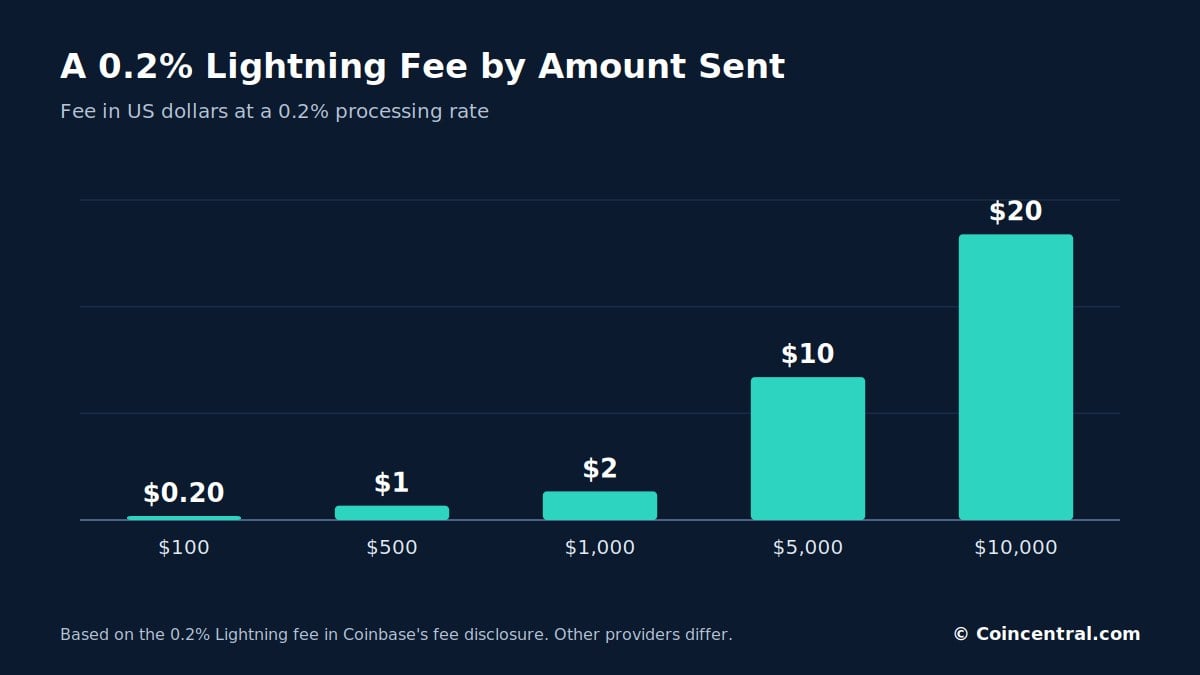
Coinbase’s fee disclosure says sending Bitcoin through Lightning has a processing fee of 0.2% of the amount. On a $1,000 transfer, that is $2. A direct Bitcoin transaction could cost less when network demand is low.
The chart below shows how a percentage fee grows with the amount sent. An on-chain Bitcoin fee is based on size, not value.
Users who run their own Lightning channels must also count the Bitcoin network costs of opening or closing channels. Lightning works best for small and frequent payments when both wallets support it and the quoted fee is low.
Hidden Costs That Can Erase Savings
Network fees are only one part of the cost. Several other charges can matter more.
Trading Fees and Spreads
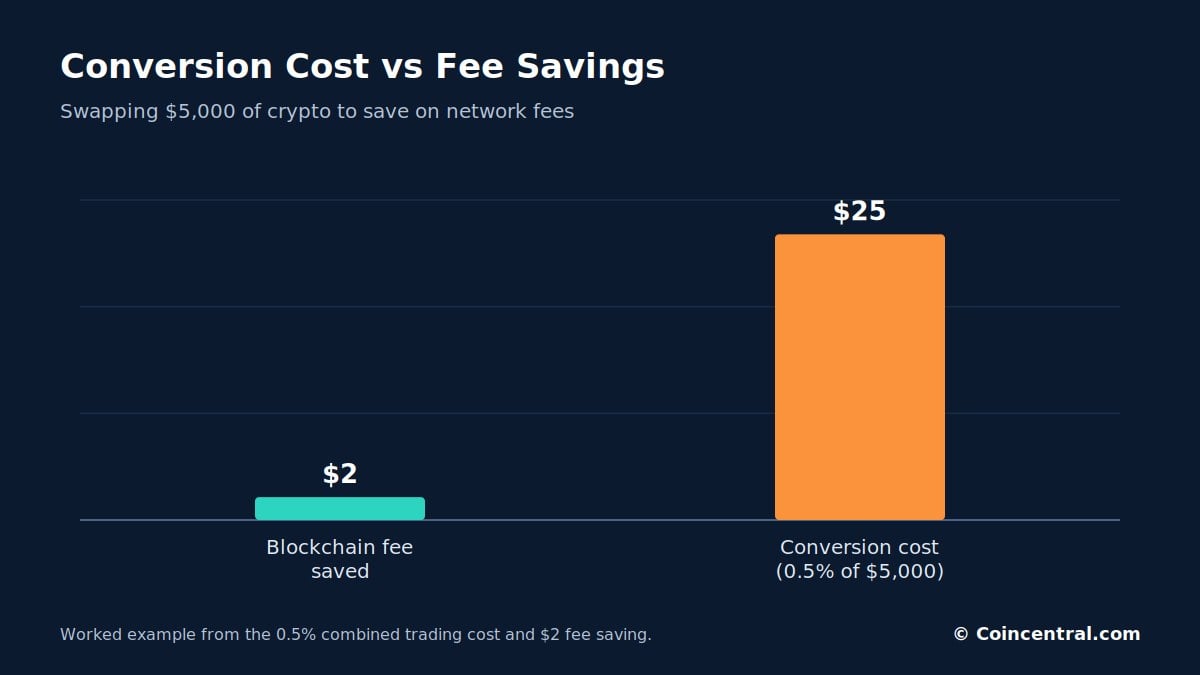
Converting a coin before a transfer can add commissions and bid-ask spreads. A combined conversion cost of 0.5% on $5,000 is $25. Saving $2 in blockchain fees would not make up for that.
Other Costs to Check
Bridging fees. Moving assets between chains can need several transactions, including smart contract approvals. A low fee on the destination chain does not remove the cost of getting there.
Withdrawal minimums. Exchanges often set a minimum withdrawal amount. Small balances may be impossible or not worth moving on some networks.
Wallet funding. Some networks need minimum balances, token account funding or a little native coin for gas. These rules can make a cheap transfer harder to complete.
Wrong network. Coinbase warns that funds sent over the wrong network may not be recoverable. Avoiding one mistake is worth more than saving a few cents.
Can You Transfer Crypto for Free?
Sometimes. Some platforms let customers send funds to other users of the same service with no blockchain fee. Coinbase documents fee-free internal transfers between eligible users.
These are off-chain transfers, where the platform updates its own records. They can be almost instant. But the platform keeps custody of the assets until they are withdrawn, so this is not the same as moving coins between self-custody wallets.
Batching, Transfer Size and Taxes
Is One Large Transfer Cheaper?
On many blockchains, one large transfer costs less than several small ones. Take an example network fee of $1 per transaction. Sending $10,000 at once costs $1, while sending it in ten parts costs $10.
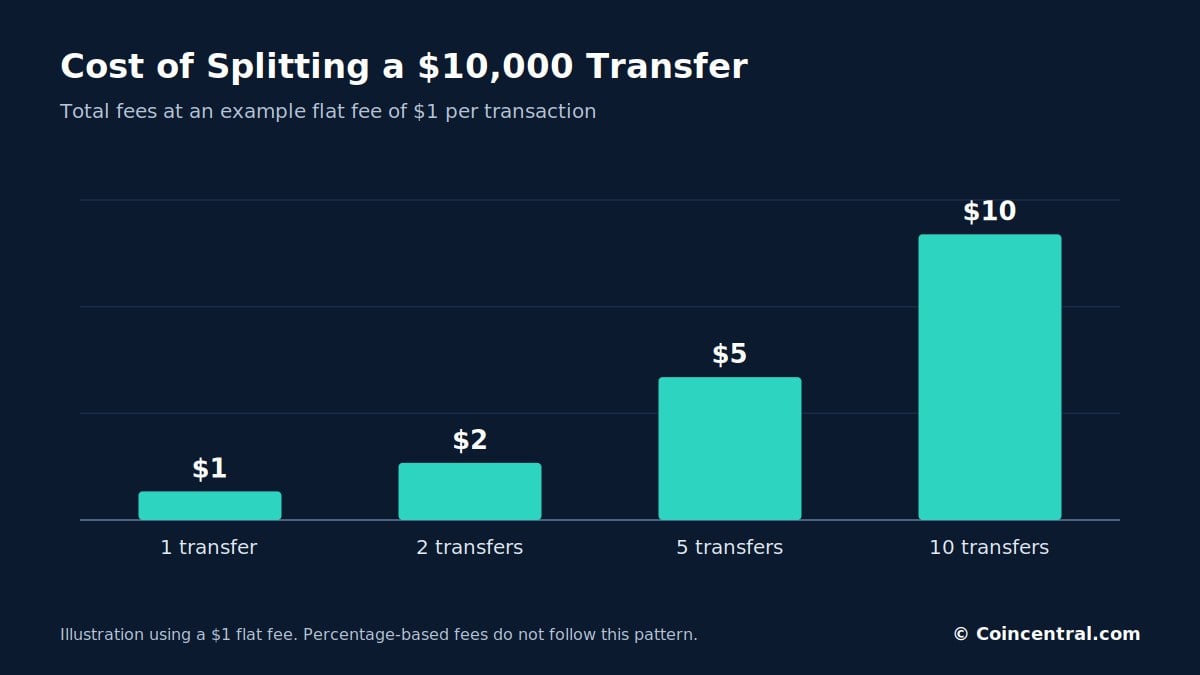
This does not apply everywhere. Bitcoin fees depend partly on the number of inputs and outputs, so combining many inputs can raise the size and the cost. Some exchange and payment fees are percentage-based as well.
Some services support batching, which puts several recipients in one transaction. Compare the real transaction setup before assuming a large transfer is cheaper.
Taxes on Transfers Between Your Own Wallets
In many places, moving crypto between wallets you own is not a taxable event. The US Internal Revenue Service generally treats transfers between a person’s own wallets as non-taxable. Crypto used to pay transaction costs may have separate tax results.
A swap is different. Trading Bitcoin for XRP before a transfer may create a taxable gain or loss, even if the XRP is traded back later. Rules differ by country, so check the ones that apply to your tax residence.
How to Move Crypto Between Wallets at the Lowest Cost
Most people can find the cheapest route by comparing a few basic options. Complex swaps are rarely needed. These six steps cover the process.
Step 1: Identify the asset and network. Check whether the coin is on Bitcoin, Ethereum, Solana, Base or another chain. The name alone is not enough, since USDC on Ethereum is not the same on-chain asset as USDC on Solana.
Step 2: Check the receiving wallet. Confirm it supports the exact coin and network. Similar-looking addresses do not mean identical support.
Step 3: Compare transfer methods. Look at direct transfers, internal platform transfers and Layer 2 withdrawals. If an exchange offers several withdrawal networks, compare the final quoted charges.
Step 4: Add up the total cost. Include exchange fees, blockchain fees, conversion costs and any bridging charges.
Step 5: Send a small test transfer. This adds one more fee. For large amounts or unfamiliar networks, the cost is often worth it.
Step 6: Send the rest. Once the test arrives, check the destination details again. Blockchain transfers generally cannot be reversed after confirmation.
Frequently Asked Questions
What Is the Cheapest Crypto to Send Between Wallets?
XRP, XLM and SOL are among the cheapest major coins to move directly between compatible wallets. Converting another coin into one of them can add costs.
Is Solana Cheaper Than Ethereum for Transfers?
Solana generally has lower fees than Ethereum mainnet for ordinary native transfers. Ethereum Layer 2 networks can also be very cheap.
Does Sending More Crypto Raise the Fee?
Not necessarily. Many blockchain fees depend on transaction size or computing needs, not the value sent. Exchanges and payment providers may still charge a percentage.
How Can I Send Bitcoin Without High Fees?
Use Lightning for compatible payments, or choose a low on-chain fee rate when demand is low. Compare the final quote, since some Lightning providers charge a percentage.
Which Is Cheaper: Binance, Coinbase or Kraken?
No exchange is always the cheapest for withdrawals. Fees depend on the asset, network, account and current pricing. Compare the amount the receiving wallet will actually get.
Can I Send Ethereum Without High Gas Fees?
Yes, if both wallets support ETH on a low-cost Layer 2 network such as Base or Arbitrum. Moving ETH from mainnet to a Layer 2 network can add bridging costs.
Bottom Line
The cheapest way to transfer crypto between wallets is usually to send the asset directly over a network both wallets support. Skip extra swaps and bridges unless the savings are clear.
Solana, Stellar and the XRP Ledger have some of the lowest base fees. Base and Arbitrum suit assets already held on Ethereum Layer 2. For Bitcoin, Lightning can work for frequent payments, though an on-chain transfer may cost less at times.
Stablecoin fees vary by network and exchange, so the chain you pick matters. Trading spreads, withdrawal charges, bridging fees and taxes can all outweigh a saving of a few cents. Compare the final amount received before you send.
Sources
- Solana Foundation: Solana Transaction Fees
- Solana Foundation: How Payments Work on Solana
- Ethereum Foundation: Ethereum Gas Fees Explained
- Ethereum Foundation: How to Bridge Tokens to Ethereum Layer 2
- XRP Ledger: Transaction Costs
- Stellar Development Foundation: Stellar Transaction Fees
- TRON Developers: Bandwidth and Energy
- Arbitrum Developers: Gas and Fees
- Kraken: Cryptocurrency Withdrawal Fees and Minimums
- Coinbase: Cryptocurrency Pricing and Fee Disclosures
- Coinbase: Sending Cryptocurrency
- Circle: How CCTP Bridging Works
- Bitcoin Mempool: Bitcoin Transaction Fee Estimates
- Internal Revenue Service: Digital Asset Transaction FAQs
Disclaimer: Crypto transaction fees change with blockchain activity, market prices and exchange policies. Figures are either protocol-level settings or clearly labeled illustrations. Always check live fees and network support before sending funds. This article is not financial or tax advice.