
Close Menu
CryptoDigestAlert.comCryptoDigestAlert.com
    What's Hot

    Crypto Funds Bleed $173M As Outflows Extend To Fourth Week

    February 17, 2026

    Nasdaq’s NewGenIVF Strikes $120M Solana Deal, Swaps Shares for 600,000 SOL

    November 1, 2025

    U.S. Treasury Sanctions 27 in Mexico Gambling Network Linked to Cartels

    November 15, 2025
    Facebook X (Twitter) Instagram
    • Privacy Policy
    • Get In Touch
    Facebook X (Twitter) Instagram
    CryptoDigestAlert.comCryptoDigestAlert.com
    • News

      Ripple partners with Stripe’s Privy to bring XRP payments to apps

      October 13, 2026

      Who Pays and Who Gains as Ledger Drama Fuels Multisig Adoption

      October 12, 2026

      Justin Sun Shares AI and Quantum Vision at TOKEN2049 Singapore and Blockworks DAS Asia

      October 11, 2026

      Charles Hoskinson Accuses Vitalik Buterin of Overstating AI Threat to Lattice Cryptography

      October 10, 2026

      Fidelity’s FBTC sheds $197 million as ether ETFs log an eighth day of outflows

      October 9, 2026
    • Technology

      Who’s Next After Bitwise’s Nine ETFs? Nine Filed Coins Are Still Waiting

      October 15, 2026

      Peter Brandt Prefers Monero as XRP Rally Faces Selling Pressure

      October 14, 2026

      Coinbase joins DOJ and UK crime agency to target West Africa scams

      October 13, 2026

      Why XRPL’s Latest Patch Redefines What “Hard-Coded” Crypto Caps Really Mean

      October 12, 2026

      Tether USDT Unfreeze Restores $1.45M Across Four THORChain Vaults

      October 11, 2026
    • Learn/Guide

      OTC Crypto Prefunding: What 100% Upfront Actually Costs

      July 29, 2026

      Wadoozie ($WADZ): The Ethereum Memecoin With a 48-State Tour and Hidden Token Rewards

      May 6, 2026

      How to Optimize Company Operational Costs: A Manual on Modern Payment Ecosystems

      March 6, 2026

      6 Best Citizenship by Investment Programs for 2026

      February 23, 2026

      Best Smart Contract Auditors and Web3 Security Companies (2026): Ranked by Verifiable Public Evidence

      February 12, 2026
    • Regulation

      WLFI Staking Locks 54.18 Million Tokens in Its First Two Weeks representing 0.17 Percent of Circulating Supply

      October 15, 2026

      Is NEAR Intents Becoming the Default Cross-Chain Layer? What the Competition Looks Like in 6 Years

      October 14, 2026

      Could Encrypted Mempools Become the Standard? What Other Chains Are Doing About MEV

      October 13, 2026

      Kalshi Investigation Examines Bets on Katie Zacharia Selection

      October 12, 2026

      Euro Stablecoin Category Shrinks to $760M as Dollar Alternatives Surge Past $300B

      October 11, 2026
    • Live Pricing Chart
    CryptoDigestAlert.comCryptoDigestAlert.com
    Home»Regulation»WLFI Staking Locks 54.18 Million Tokens in Its First Two Weeks representing 0.17 Percent of Circulating Supply
    Regulation

    WLFI Staking Locks 54.18 Million Tokens in Its First Two Weeks representing 0.17 Percent of Circulating Supply

    October 15, 20264 Mins Read
    Facebook Twitter Pinterest LinkedIn Tumblr Email
    The Merkle logo
    Share
    Facebook Twitter LinkedIn Pinterest Email


    World Liberty Financial’s WLFI staking dashboard displays 54.18 million tokens locked, whereas Jupiter registers over one billion JUP staked.

    At first glance, the first figure looks modest while the second appears massive. Neither number carries much meaning, however, until each is evaluated relative to its actual circulating supply.

    Comparing Two Distinct Staking Programs and Terms

    WLFI staking officially went live on October 1, 2026. According to the official World Liberty Financial staking portal, participants earn potential rewards paid in USD1, the project’s native stablecoin, drawn from a shared distribution pool. New stakes require a minimum 180-day lockup period, and rewards remain non-guaranteed. In addition to the lockup, a September 14 governance proposal requires stakers to vote directly on at least one proposal every 90 days to maintain reward eligibility.

    Meanwhile, Jupiter’s program operates under very different mechanics. On the official Jupiter vote portal, token holders stake JUP, vote on active protocol decisions, and earn JUP payouts through Active Staking Rewards every quarter. Unlike WLFI participants, Jupiter stakers retain the flexibility to unstake their holdings at any time.

    Examining the On-Chain Baseline Numbers

    On October 14, the WLFI dashboard recorded 54.18 million WLFI staked alongside a variable annualized rate of 82.41%, reflecting 1.25 million USD1 in all-time allocated rewards and 1.17 million USD1 currently available. Furthermore, official program guidelines warn that this percentage will decline as additional WLFI joins the pool, meaning the current figure does not serve as a forward yield projection.

    By comparison, Jupiter’s governance dashboard recorded 1,121,948,276 JUP staked across 357,681 distinct staker addresses that same evening, with an estimated APY of 17.83%. As a result, the average position works out to approximately 3,137 JUP per staker, or roughly $1,000 at recent valuations. This metric points toward a broad foundation of small and mid-sized retail holders rather than a concentration of large whale wallets.

    WLFI Staking Locks 54.18 Million Tokens in Its First Two Weeks representing 0.17 Percent of Circulating Supply

    Normalizing Both Token Programs on the Same Scale

    Because total token supplies differ fundamentally, comparing raw asset counts produces a misleading picture. WLFI maintains a maximum supply cap of 100 billion tokens alongside roughly 31.78 billion tokens in active circulation. Conversely, Jupiter features a 7 billion maximum token cap with approximately 3.32 billion JUP in active circulation.

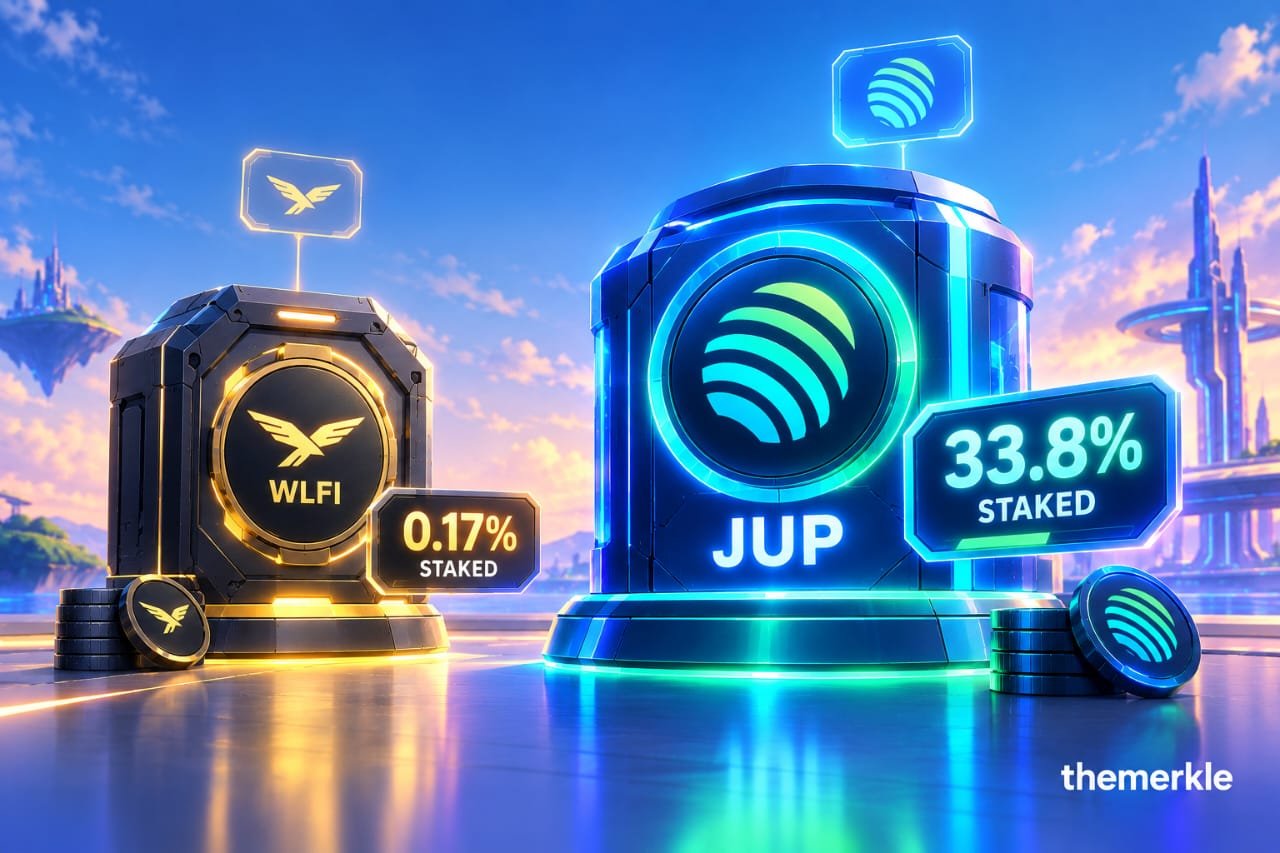
    When evaluated against active circulating supply, WLFI’s 54.18 million staked tokens come out to about 0.17%, whereas Jupiter’s 1.12 billion staked tokens represent roughly 33.8% of circulating supply. Evaluated against maximum supply caps, the figures come out to roughly 0.05% for WLFI and 16.0% for JUP. In other words, Jupiter’s relative staking participation rate is about 198 times higher than WLFI’s. Measured in overall monetary value, the gap narrows but remains substantial, showing roughly $371 million locked in JUP versus $3.1 million in WLFI, representing a 120-fold difference.

    WLFI Staking Locks 54.18 Million Tokens in Its First Two Weeks representing 0.17 Percent of Circulating Supply

    Analyzing Why the Staking Participation Gap Is So Wide

    The primary driver behind this disparity is operational age. While WLFI staking is only two weeks old, Jupiter’s program has operated for years and has had ample time to cultivate participant habits.

    Beyond timeline differences, capital exit terms play an even larger role. Jupiter allows users to unstake capital at any time, rendering staking a fully reversible financial decision. On the other hand, WLFI locks every new deposit for a minimum of 180 days. Consequently, participants who staked on October 1 remain committed until approximately March 30, 2027.

    In addition, WLFI demands extra active management from its user base. Earning rewards depends on casting governance votes at least once every 90 days, a condition that Jupiter stakers do not have to fulfill. Together, these three constraints make committing capital to WLFI a significantly heavier decision than participating in Jupiter’s pool.

    Finally, the two reward structures differ in asset classification. Jupiter distributes rewards in native JUP tokens, meaning real participant returns depend directly on JUP spot market prices and potential dilution from new token supply. In contrast, WLFI pays out in a dollar-pegged stablecoin, ensuring the reward payout value itself does not fluctuate with WLFI price action, even though the underlying staked WLFI asset remains exposed to market volatility.

    Disclosure: This is not trading or investment advice. Always do your research before buying any cryptocurrency or investing in any services. 

    Follow us on Twitter @themerklehash to stay updated with the latest Crypto, NFT, AI, Cybersecurity, and Metaverse news!


    Source link

    Share. Facebook Twitter Pinterest LinkedIn Tumblr Email

    Related Posts

    Is NEAR Intents Becoming the Default Cross-Chain Layer? What the Competition Looks Like in 6 Years

    October 14, 2026

    Could Encrypted Mempools Become the Standard? What Other Chains Are Doing About MEV

    October 13, 2026

    Kalshi Investigation Examines Bets on Katie Zacharia Selection

    October 12, 2026

    Euro Stablecoin Category Shrinks to $760M as Dollar Alternatives Surge Past $300B

    October 11, 2026
    Top Posts

    Bitcoin Supply Shock Brewing? Whales Step Back As Long-Term Holders Absorb $49 Billion

    April 12, 2026

    How to Participate in the Variational Airdrop and Earn VAR Crypto Rewards

    September 28, 2026

    OpenSea Sets the Stage for SEA Token Launch: Timeline Revealed

    October 19, 2025

    Welcome to CryptoDigestAlert.com! Your go-to source for fast, reliable updates from the ever-evolving world of cryptocurrency. Whether it's Bitcoin, altcoins, blockchain breakthroughs, or DeFi trends, we bring you timely insights, expert analysis, and key developments shaping the future of digital finance. Stay ahead with real-time crypto news and in-depth coverage.

    Top Insights

    Ripple partners with Stripe’s Privy to bring XRP payments to apps

    October 13, 2026

    Who Pays and Who Gains as Ledger Drama Fuels Multisig Adoption

    October 12, 2026

    Justin Sun Shares AI and Quantum Vision at TOKEN2049 Singapore and Blockworks DAS Asia

    October 11, 2026
    Advertisement
    Demo
    • News
    • Technology
    • Learn/Guide
    • Regulation
    • Business
    • Live Pricing Chart
    © 2026. Burleys Holdings Ltd Company Reg: 15927118 - Unit 15 Manor Farm, Tarnock, Axbridge, UK, BS26 2SL - Design & SEO + GEO Developed By SEO - Craig Burley

    Type above and press Enter to search. Press Esc to cancel.