
Imagine you’re stuck in traffic, waiting forever to get where you need to go. Now, imagine there’s a new highway built just for you—no traffic, no delays, just smooth sailing. That’s Avalanche (AVAX) in the world of crypto. It’s designed to be faster, cheaper, and more scalable than many of its competitors, including Ethereum. But does it live up to the hype? Let’s dive into everything you need to know about Avalanche.
What is Avalanche?
Avalanche is a blockchain platform that’s designed for speed, low transaction fees, and scalability. Think of it as Ethereum’s faster, younger cousin. It allows developers to create decentralized applications (DApps) and even launch their own blockchains (subnets) while keeping everything running smoothly.
It was built to solve some of the biggest problems in crypto: slow transaction speeds, high fees, and network congestion. Ethereum, for example, sometimes struggles with high fees and slow transactions during peak times. Avalanche aims to fix that by offering near-instant finality and extremely low costs.
At its core, Avalanche has its own cryptocurrency called AVAX. It’s used for staking, paying fees, and securing the network. But the real magic of Avalanche lies in its unique structure. Unlike traditional blockchains, Avalanche operates on three different blockchains, each with a specific purpose. We’ll get into how that works in a bit.
History of Avalanche
Avalanche was created by Ava Labs, a company founded by Emin Gün Sirer, a Cornell University professor and blockchain expert. The project started in 2018, and by 2020, it officially launched.
Here’s a quick timeline:
- 2018 – The Avalanche consensus mechanism was first introduced by a team of researchers.
- 2019 – Ava Labs raised funding and started working on the network.
- 2020 – Avalanche launched its mainnet, making it publicly available.
- 2021 – Avalanche gained massive traction, with AVAX’s price skyrocketing and partnerships forming.
Since then, it has become one of the top blockchains, attracting developers, institutions, and crypto enthusiasts.
History of Avalanche
- 2018 – The Avalanche consensus mechanism was first introduced.
- 2019 – Ava Labs raised funding and started working.
- 2020 – Avalanche launched its mainnet.
- 2021 – Avalanche gained massive traction.
How Does Avalanche Work?
Unlike traditional blockchains, Avalanche doesn’t rely on a single chain. Instead, it uses three different chains to improve efficiency:
- X-Chain (Exchange Chain) – This handles asset creation and transfers, similar to how Bitcoin is used for transactions.
- C-Chain (Contract Chain) – This is where smart contracts are executed, making it compatible with Ethereum’s DApps.
- P-Chain (Platform Chain) – This manages validators and helps create custom subnets (individual blockchains).
Why does this matter? Because by splitting tasks between these chains, Avalanche avoids congestion, making transactions super fast and cheap.
For example, Ethereum processes around 15 transactions per second (TPS). Avalanche? It can handle over 4,500 TPS. That’s a game-changer.
Advantages of Avalanche
Avalanche has some major advantages that make it stand out:
- Speed – Transactions settle in less than two seconds. No more waiting for minutes or even hours.
- Low Fees – Compared to Ethereum’s sometimes ridiculous gas fees, Avalanche keeps costs low.
- Scalability – The network doesn’t slow down even when usage increases.
- Ethereum Compatibility – Developers can easily move their projects from Ethereum to Avalanche.
- Security – Avalanche’s unique consensus mechanism makes it more resistant to attacks.
- Eco-Friendly – Unlike Bitcoin, which uses proof-of-work (PoW), Avalanche uses proof-of-stake (PoS), which is much more energy-efficient.
Disadvantages of Avalanche
- Competition – Ethereum, Solana, and others are also working on scalability solutions.
- Centralization Concerns – Some critics argue that a small number of validators control most of the AVAX supply.
- Adoption – While growing, it still needs more developers and projects to truly compete with Ethereum.
Is Avalanche a Good Investment?
This is the big question: should you invest in AVAX?
Like any crypto, AVAX has had its ups and downs. It saw huge gains in 2021, reaching an all-time high of around $146. However, it also faced major corrections.
Here’s why some investors are bullish:
- Strong technology – Avalanche’s speed and low fees make it attractive for DApps.
- Growing ecosystem – More projects are launching on Avalanche.
- Institutional interest – Big players are taking notice.
But there are risks too:
- Crypto volatility – Prices can swing wildly.
- Regulatory uncertainty – Governments may crack down on crypto.
- Competition – Ethereum and others aren’t standing still.
If you believe in Avalanche’s long-term potential, it could be a solid investment. But always do your research and never invest more than you can afford to lose.
Is Avalanche a Good Investment?
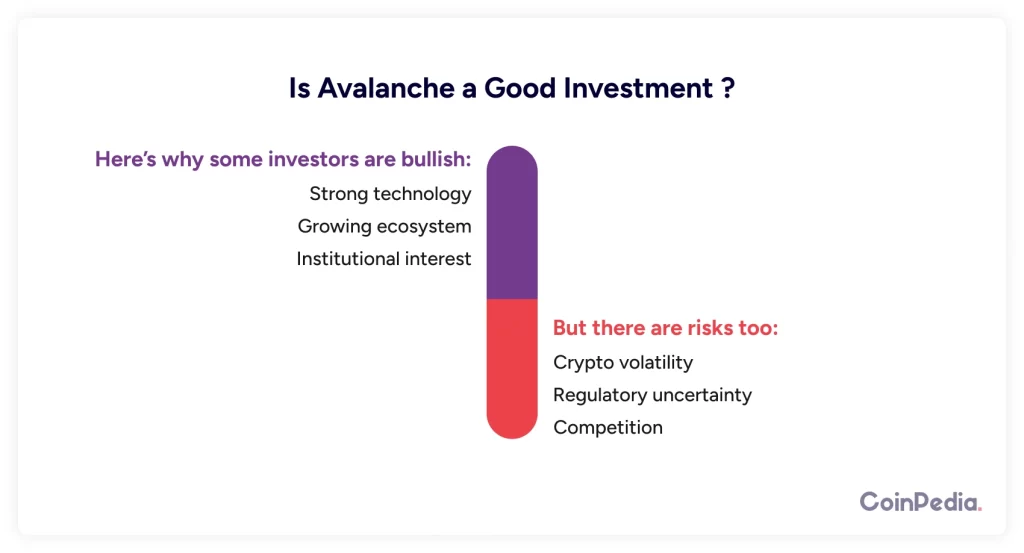
Here’s why some investors are bullish:
- Strong technology
- Growing ecosystem
- Institutional interest
But there are risks too:
- Crypto volatility
- Regulatory uncertainty
- Competition
The Future of Avalanche
Avalanche has a bright future, but it won’t be an easy ride. Here’s what could happen next:
- More Adoption – If more developers and institutions join, Avalanche could challenge Ethereum.
- Better Upgrades – Avalanche continues to improve its scalability and security.
- Stronger Partnerships – More collaborations could boost its ecosystem.
- Price Growth? – If demand increases, AVAX could see price appreciation.
Of course, nothing is guaranteed in crypto. Avalanche has potential, but it also faces challenges.
Final Thoughts
Avalanche is like the high-speed train of the crypto world. It’s fast, efficient, and designed to handle huge amounts of traffic without slowing down. If you’re into crypto, it’s definitely worth keeping an eye on.
Will it replace Ethereum? Maybe not. But will it play a major role in the future of blockchain? Very likely.
So, whether you’re an investor, developer, or just curious about crypto, Avalanche is one name you should know.
FAQs
Avalanche is a fast, low-cost blockchain using three chains (X-Chain, C-Chain, P-Chain) to improve scalability and efficiency.
Avalanche is faster (4,500 TPS vs. Ethereum’s 15 TPS), has lower fees, and supports subnets for custom blockchains.
AVAX has strong tech, growing adoption, and institutional interest but faces risks like volatility and competition.
Avalanche aims for wider adoption, better upgrades, stronger partnerships, and potential price growth in the crypto space.