
There’s a specific kind of dread that comes from watching a wallet address on a block explorer just… sit there. Not moving. Not being touched by any exchange freeze, any law enforcement flag, any of the usual friction that at least slows a thief down.
Just sitting on $9.4 million, quietly converted and consolidated, while fifteen people somewhere are staring at their transaction history trying to figure out exactly when their money stopped being theirs. That’s the situation unfolding right now around a single Tron wallet, and the mechanics behind it are almost insultingly simple once you understand them.
What Happened Over The Past Four Weeks
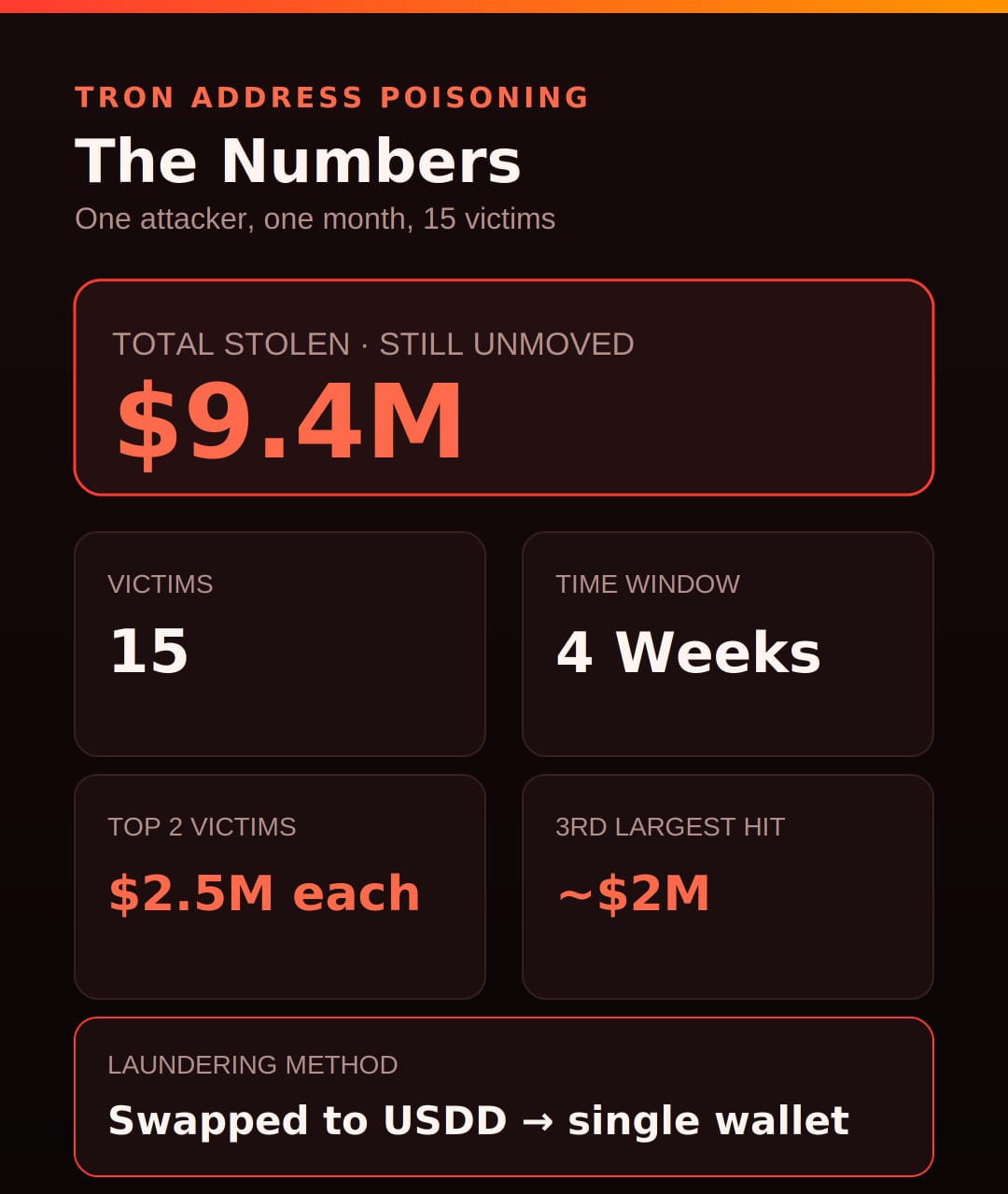
According to on-chain analysis shared by blockchain investigator Specter, fifteen separate victims have lost a combined $9.4 million to a single address poisoning attacker operating over the past four weeks.
The two largest victims alone accounted for $2.5 million each, with at least one other target losing roughly $2 million in a single incident. What stands out in that data isn’t just the total, it’s the consistency. This wasn’t one lucky strike against a careless whale. It was a sustained, repeated operation against a rotating cast of targets, all falling for the same trick within the same narrow window.
Where The Stolen Money Actually Went
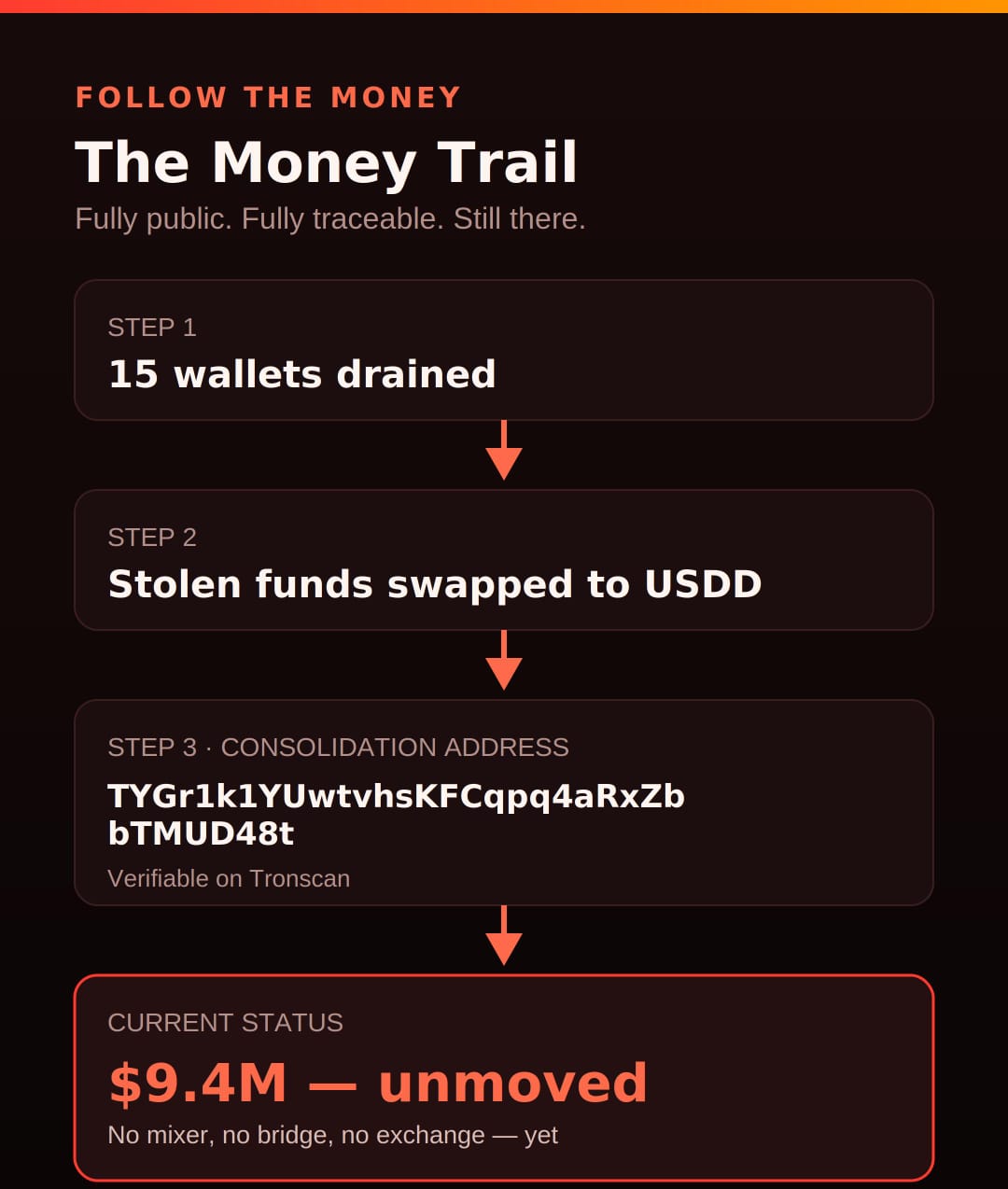
Once each theft occurred, the pattern was identical. The stolen funds were immediately swapped into USDD, Tron’s native decentralized stablecoin, and funneled into a single consolidation address rather than being scattered across dozens of wallets or run through a mixing service right away. That address, publicly viewable on Tron’s blockchain, is:
TYGr1k1YUwtvhsKFCqpq4aRxZbbTMUD48t
Anyone can verify the current balance and full inbound transaction history of that wallet directly on Tron’s official block explorer, Tronscan, which independently confirms the scale of funds that have moved through it. As of the most recent reporting, the full $9.4 million remains sitting in that address, unmoved and unlaundered any further, which is itself unusual. Most large-scale crypto thefts see rapid layering through mixers, cross-chain bridges, or decentralized exchanges within hours. A month-long static balance suggests either extreme confidence that no freeze or law enforcement action is coming, or a deliberate wait for scrutiny to die down before the next move.
How Address Poisoning Actually Works
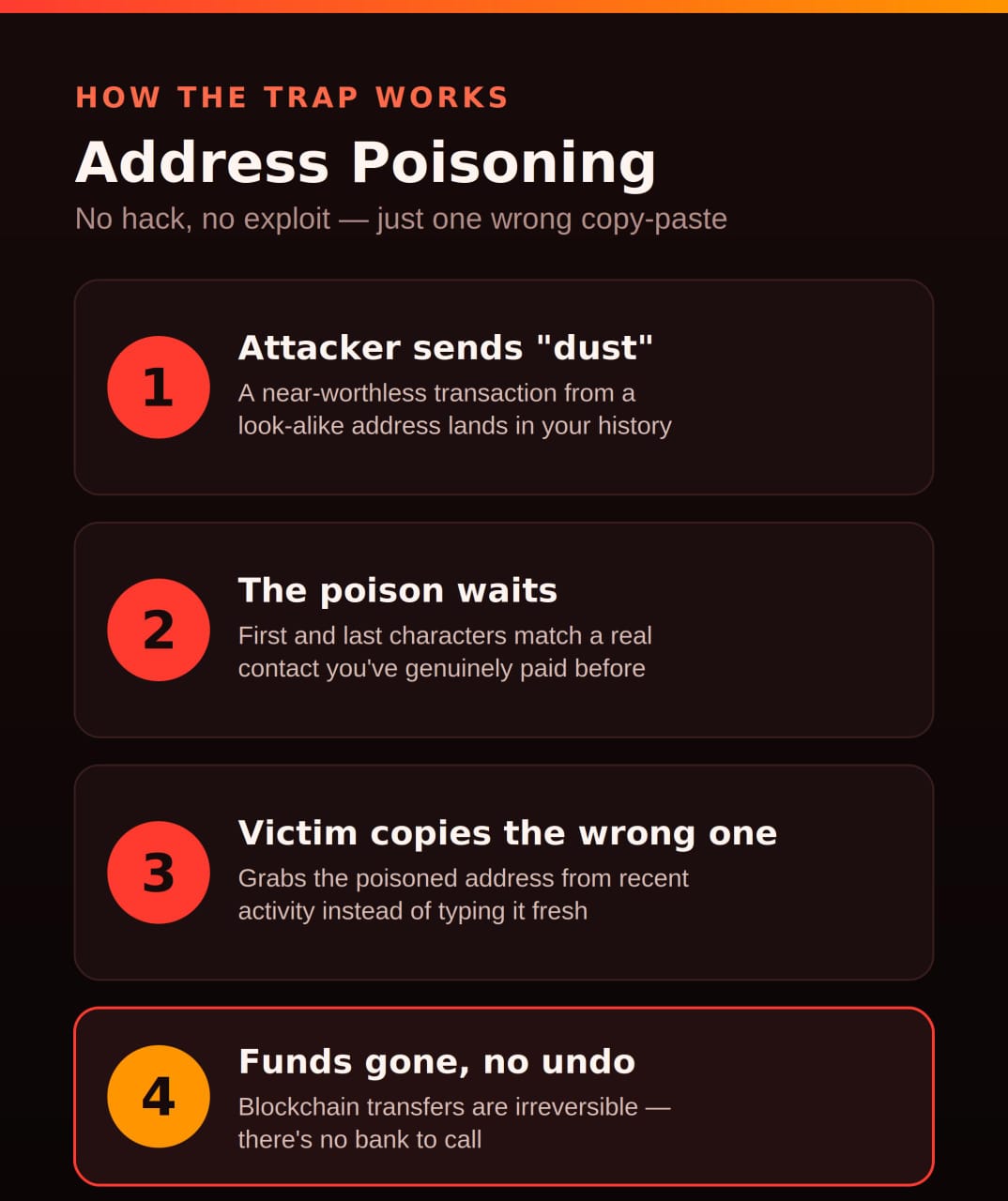
For anyone unfamiliar with the mechanics, address poisoning is deceptively low-tech compared to most headline-grabbing crypto hacks. There’s no smart contract exploit, no stolen private key, no phishing link clicked in a moment of distraction. The attacker simply sends a tiny, often near-worthless “dust” transaction to a target’s wallet from an address they’ve generated to closely resemble one the victim has genuinely transacted with before, usually matching the first and last few characters. That poisoned address then sits quietly in the victim’s transaction history, waiting.
The trap springs the next time the victim needs to send funds to their real, trusted counterparty and, instead of typing the full address manually, copies it from their recent activity log. If they grab the wrong entry, the money goes straight to the attacker instead, and because blockchain transactions are irreversible by design, there’s no bank to call and no undo button once it’s confirmed. Tron has been a particularly common battleground for this style of attack historically, largely because it processes the overwhelming majority of global USDT volume and its transaction fees are cheap enough that an attacker can blast poisoned dust transactions to thousands of wallets for fractions of a cent.
Why This Case Is Different From The Usual Headlines
Address poisoning isn’t new, and eye-watering individual losses have made headlines before, including a widely reported case of a single trader losing nearly $50 million in one mistaken transfer late last year. What makes this Tron case notable isn’t the size of any one loss, it’s the volume and consistency: fifteen distinct victims, hit over a rolling four-week period, all funneled into the same consolidation point using the same laundering method. That pattern points to an organized, repeatable operation rather than an opportunistic one-off, and it raises an uncomfortable question about how many more victims may already be poisoned and simply haven’t made the fatal copy-paste yet.
The Case For Wallet Providers To Step In
The recurring theme across nearly every documented address poisoning case, this one included, is that the technology to prevent it already exists and simply isn’t deployed widely enough. Wallet interfaces that visually flag look-alike addresses, warn users before confirming a transfer to a previously-unused address, or hide zero-value dust transactions from transaction history entirely, would sharply cut the surface area this entire attack style depends on. Some wallets and explorers have begun rolling out exactly these kinds of warnings, but adoption across the Tron ecosystem specifically remains inconsistent, and this case is a fairly direct argument for why that needs to change faster than it has been.
When the attacker’s entire strategy depends on a victim’s eyes skipping past a few mismatched characters, the fix isn’t asking millions of users to become more careful. It’s building interfaces that make the mistake structurally harder to make in the first place.
What Happens Next
For now, the $9.4 million sits untouched at a fully public, fully traceable address, which cuts both ways. It means investigators, exchanges, and blockchain analytics firms can watch it in real time for any sign of movement toward an exchange or mixing service, the moment where recovery or freezing becomes at least theoretically possible.
It also means the attacker knows exactly the same thing, and has apparently decided patience is a better strategy than speed. Whether that patience runs out before someone finds a way to act on it is the open question hanging over this case, and over the fifteen people who already know, in the worst possible way, how little margin for error a single copied address actually leaves.
Disclosure: This is not trading or investment advice. Always do your research before buying any cryptocurrency or investing in any services.
Follow us on Twitter @themerklehash to stay updated with the latest Crypto, NFT, AI, Cybersecurity, and Metaverse news!